Artificial intelligence
An AI may already be quoting you, and you have no idea
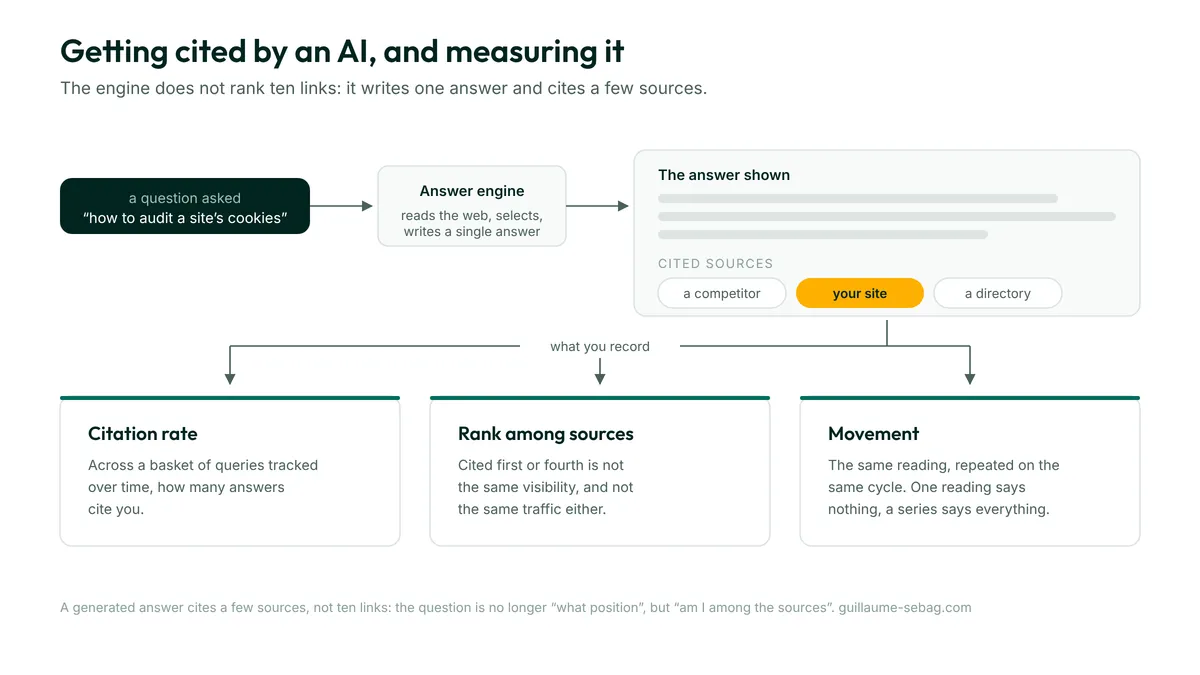
Since 22 July 2026, Google AI Overviews and AI Mode have been live in France. Search Console opened a dedicated generative AI report in early June 2026: it gives impressions inside AI answers, but neither clicks nor queries. In other words, you now know that you appear, you still do not know what it brings in. Measuring what exists beats measuring nothing at all.
Contents
If Google Tag Manager is a name you keep meeting without quite knowing what it covers, the page on understanding Google Tag Manager lays the groundwork.
What changed on 22 July 2026
Since 22 July 2026, Google AI Overviews and AI Mode have been live in France. France was the last major market to receive them, which carries an unexpected advantage: the English speaking markets served as an observation ground for two years, and the figures exist.
In practice, two things now share a results page. The AI Overview, a written summary placed above the classic links. And AI Mode, a separate conversational experience powered by Gemini.
For a business owner looking at their analytics, the consequence is simple: a share of the people searching your topic now get their answer without ever reaching you.
What the figures actually say
Three independent measurements converge, and that is what makes them credible.
The July 2025 Pew Research study tracked the real browsing of 900 US adults across 68,879 Google searches in March 2025. When an AI summary appears, a classic link is clicked in 8% of visits. Without an AI summary, that figure rises to 15%. Clicks on a link inside the summary itself account for just 1% of visits.
The same study shows something quieter and more telling: the session ends on the results page in 26% of cases with an AI summary, against 16% without. People are not going elsewhere, they are stopping.
Seer Interactive measured a 61% drop in organic click through rate on informational queries, from 1.76% to 0.61%, with a partial rebound leaving a lasting 37% gap. Ahrefs, in a December 2025 update, measured a 58% drop in click through rate at position one.
One useful nuance: transactional queries are far less affected. Someone who wants to buy still clicks. Someone who wants to understand does not.
The Search Console generative AI report, and its hole
Google has been rolling out, since early June 2026, a report dedicated to AI surfaces inside Search Console.
What it gives: impressions, meaning how often one of your URLs appears inside an AI generated answer. Broken down by canonical URL, country, device type and time period.
What it does not give: clicks and queries.
Take a second to weigh what that means. You can know your page was quoted four hundred times last month. You cannot know whether those four hundred quotes brought a single visit, nor which question they appeared on. It is like receiving a tally of how often your name was spoken in a room, without knowing in which conversation or to what effect.
That hole is not a reason to measure nothing. It is a reason to measure what exists, while knowing precisely what you do not know.
What I actually watch
Here is the routine I apply, with no paid tool.
The Search Console generative AI report, once a month. Note the impression volume and above all which URLs come up. The pages an AI quotes are almost never the ones you would have bet on. They tend to be the most factual pages, not the most commercial ones.
The classic Performance report, alongside it. If impressions rise while clicks stay flat, the gap is opening somewhere. That is the most reliable signal available to you today.
Ten commercial queries tested by hand, every month. Put them to ChatGPT, Perplexity and Google AI Mode, and note whether you are quoted, and who is quoted in your place. It is manual, it takes twenty minutes, and it is currently the only way to get the qualitative data Search Console does not provide.
Your share of direct and branded traffic. When an AI mentions your name without a clickable link, the effect shows up elsewhere: someone types your name into Google a few days later. A rise in branded searches with no campaign to explain it is often the trace of an invisible AI citation.
What it changes in the writing
Generative engines do not quote a page, they quote a passage. That sentence sounds unremarkable, yet it changes how you write.
A quotable block keeps its meaning out of context. If your paragraph opens with “as we saw above”, it is unusable. If it opens with “the organic visibility diagnostic is delivered in three weeks and covers a 90 day plan”, it can be lifted as is.
Name entities explicitly. Repeat the brand, product or place name rather than writing “it” or “the latter”. Slightly heavier to read, infinitely more quoted.
Give figures with their source. A sourced figure is what gets quoted first. An unsourced figure is what you will be called out on.
To place this shift in the long history of the craft, the understanding SEO page retraces the previous turning points, from Florida in 2003 to the Helpful Content Update in 2022. AI Overviews are the sixth, not the first.
None of these three rules is new. They are the same advice given for featured snippets ten years ago. That is precisely why part of the industry finds the word GEO irritating, and I understand them: the work has not changed, only the display surface has.
What I do not promise
Nobody can guarantee you a citation in ChatGPT or in an AI Overview. There is no button, no magic tag, no sign up form.
What exists is a set of signals that raise the probability of being picked up, and partial data to check whether it is working. That is little. It still beats flying without instruments.
If your current data is already unreliable, start there. Adding a layer of AI measurement on top of an approximate GA4 setup is like fitting a GPS to a car whose speedometer is broken.
Frequently asked questions
What exactly is GEO?
GEO refers to optimizing for AI assisted search engines, the ones that produce a written answer rather than a list of links. Part of the SEO industry considers it an acronym invented to sell consulting, and that criticism is not entirely undeserved. What is verifiable is that these engines quote passages rather than whole pages.
Does Search Console show clicks from AI answers?
No. The generative AI report, rolling out since early June 2026, gives impressions, broken down by URL, country, device and time period. It gives neither clicks nor queries. So you know you appear, without knowing whether that appearance brings anyone to you.
Do AI Overviews really reduce traffic?
Every available measurement points the same way. The July 2025 Pew Research study, run on 900 US adults and 68,879 searches, observed a click on a classic result in 8% of visits when an AI summary is present, against 15% when it is not. Seer Interactive measured a 61% drop in organic click through rate on informational queries, with a lasting 37% gap after a partial rebound.
Should you opt out of AI answers?
A Search Console control lets you withdraw from Google AI surfaces. Withdrawing removes the impressions, but also the traffic that follows from them, and leaves you invisible on a surface your competitors will occupy. In most cases the arithmetic does not favour it.
How do you make content quotable by an AI?
Write blocks that keep their meaning out of context, name entities explicitly instead of using pronouns, and give figures with their source. In a FAQ, deliver the answer in the first two sentences. An answer that starts with 'it depends on several factors' will never be picked up.