SEO
SEO cannibalization: when two of your pages cancel each other out
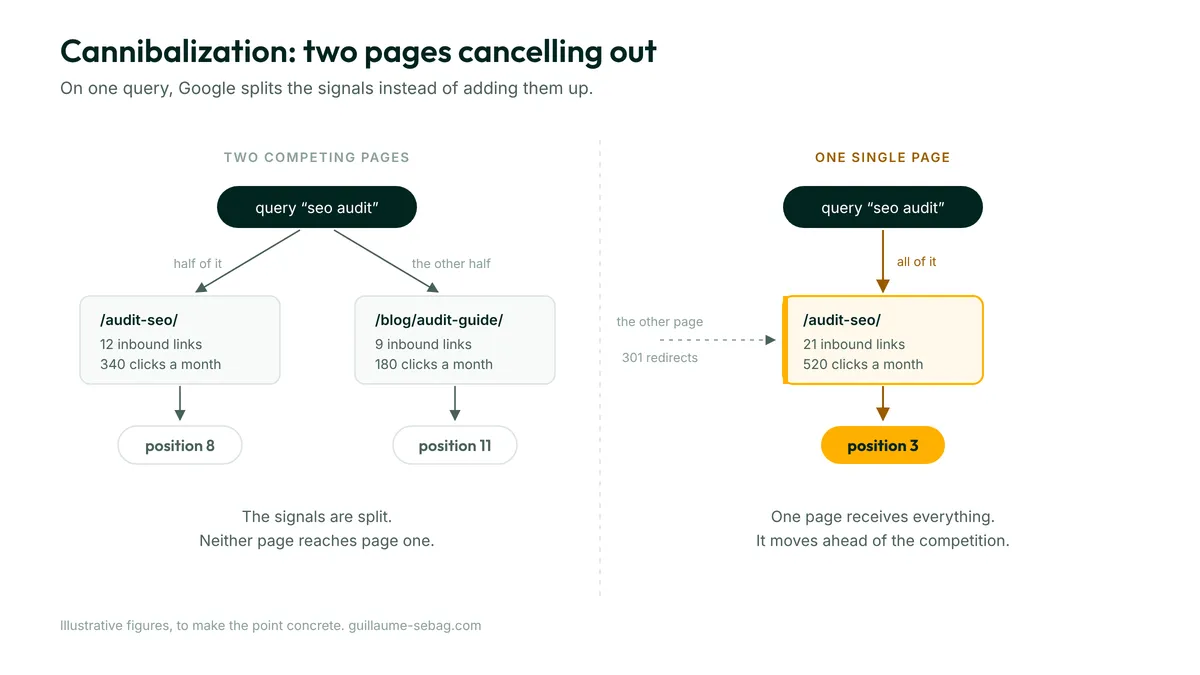
Cannibalization is not duplicate content. It is two distinct pages answering the same search intent, so they split links, clicks and Google's trust instead of accumulating them. You spot it by crossing queries with pages in Search Console, and you fix it with a decision: merge, redirect, or refocus one of the two.
Contents
Cannibalization is one case of a broader problem: a site sending contradictory signals to an engine trying to understand it. For the full context, the understanding SEO page tells how engines came to judge sites that way.
What cannibalization is not
Cannibalization is not duplicate content, and confusing the two leads to the wrong fix.
Duplicate content means several addresses showing the same text: a product page reachable with and without a URL parameter, an http and an https version, a printable view. Google picks one and ignores the rest. It is a technical problem, solved with redirects and canonical tags.
Cannibalization is something else. It is two different pages, with different text, answering the same search intent. Nothing is duplicated, and yet both lose.
They lose because inbound links split between them instead of accumulating on one, because clicks divide, and because Google, not knowing which one you want to rank, alternates between them.
How to spot it in ten minutes
The only place that shows the problem is the Search Console performance report, because it crosses what people search with what Google shows them.
The procedure takes three moves.
One. Open the Performance report and set the period to twelve months. Too short a window hides the alternation, which is exactly the symptom.
Two. In the Queries tab, click a query that matters, then switch to the Pages tab. You now see which URLs Google associates with that query. If two URLs appear, note them.
Three. Go back to the period and compare how both URLs evolve. The telling pattern is alternation: page A surfaces for a few weeks, then page B takes its place, then A returns. Neither settles.
There is a quieter variant: a single page surfaces, but it has been stuck around position ten for months while another page on the site covers exactly the same subject. Internal links scatter between the two, and neither reaches critical mass.
The four situations, and the decision that goes with each
Every cannibalization is solved by a decision, never by a technical trick. Here are the four cases and what I do in each.
Both pages say the same thing to the same audience
Merge them. Keep the one with the most inbound links and the older history, pull into it whatever the other did better, then redirect the old URL with a 301. A redirect is the strongest consolidation signal Google has.
One page targets commercial intent, the other informational intent
Do not merge, separate. The commercial page keeps the main query. The informational page is rewritten to target an adjacent, longer query, and it sends a contextual link to the commercial page. You turn a conflict into a pair that works together.
One page is clearly weaker and adds nothing
Remove it and redirect its address to the surviving page. A page with no traffic, no links and no conversions costs crawl budget and dilutes how the site is perceived.
Both pages are useful but poorly connected
Sometimes there is no real intent conflict, only fuzzy internal linking. Review the anchors: the ones pointing to page A must carry page A’s keyword, never page B’s. A badly chosen anchor is enough to send Google in the wrong direction.
What Google does when you do not decide
Google always ends up choosing for you, and it does not necessarily choose the page you would have kept.
Its documentation is explicit: with no indication from you, it identifies the version it considers best to show. To do that it weighs several signals, from strongest to weakest.
Redirects are a strong signal in favour of the destination page. The rel="canonical" tag is also a strong signal, but remains a preference Google may not follow. Sitemap inclusion is only a weak signal. Internal links help Google understand which URL you prefer, provided they are consistent.
These methods stack: they become more effective when combined. A redirect, plus a canonical, plus consistent internal links, plus sitemap presence, all say the same thing four times.
One point is worth repeating: the canonical tag is designed for identical content. On two pages with different content targeting the same query, it does not solve the editorial problem. It hides the symptom.
How to stop creating them
Cannibalization is prevented when you choose a topic, not when you publish.
This is one of the checks I always run in the SEO and GEO visibility diagnostic. Before writing a new page, I systematically check that no existing page already targets the keyword. On this site the check is automated: two pages declaring the same primary keyword make the build fail. That is blunt, and that is exactly the point.
Second habit: look at the results page before choosing a format. If Google only surfaces service pages on a query, publishing an article on it creates a needless overlap with your own service page.
Third habit: when placing internal links to a new page, reread the anchors already used elsewhere. The same anchor pointing to two different destinations is the starting point of most cannibalization I come across.
Frequently asked questions
What is the difference between cannibalization and duplicate content?
Duplicate content means several URLs showing the same content, and Google picks one to index. Cannibalization means different pages, with different text, answering the same search intent. The first problem is technical, the second is editorial, and they are not fixed the same way.
How do you detect cannibalization in Search Console?
Open the Performance report, filter on one query, then switch to the Pages tab. If two URLs appear for that same query, you have a conflict. The clearest sign is alternation: one page surfaces for a few weeks, then the other takes its place, and neither settles.
Should you always merge the two pages?
No. Merging only makes sense when both pages say the same thing to the same audience. If one targets a commercial intent and the other an informational one, it is better to rewrite the second so it targets an adjacent query and links to the first.
Is a canonical tag enough to fix it?
No, not for genuine cannibalization. Google treats the canonical tag as a strong signal but as a preference, not an absolute instruction, and it is designed for identical content. On two pages with different content, it does not resolve the intent conflict.
How long before you see an effect after fixing it?
Expect a few weeks, the time Google needs to recrawl the pages and consolidate signals onto the chosen URL. An indexing request in Search Console and a few internal links to the surviving page speed things up.